
How Bleach Transcends Fiction to the Real World

Why Bleach?
The manga is known for its in-depth character stories, appeal to teenage viewers, and action-filled arcs. But what does this have to do with real life? Why not a slice-of-life or romcom series? Bleach fans have realized just how much Tite Kubo, the author of the series, has based his characters, societies, and fictional power system around real life. Bleach It centers around growth, self-acceptance, and larger issues that affect us all. If you haven’t watched or read Bleach I’d recommend watching it before reading this article because of major spoilers.
Synopsis
Bleach takes place in three worlds: the Human World, much like that of our reality; Soul Society, where soul reapers and souls reside; and Hueco Mundo, the world where Hollows reside. The story begins when a ghost-seeing highschooler by the name of Ichigo Kurosaki, named after his bright strawberry colored hair, accidentally gets himself involved with an incident between a Hollow, a monster constructed of human souls, and a Soul Reaper, a person that balances the worlds by using spirit controlled swords which can transfer lost souls to the Soul Society before a Hollow takes them. The Soul Reaper, Rukia Kuchiki, was forced to transfer her powers to Ichigo who takes over the job as a substitute while balancing his regular human life. A thousand years before this story started, a human race called Quincies used spiritual powers to eradicate Hollows, and were believed to be extincted through mass genocide. Ichigo’s dad is one of the Quincies, and his mom was attacked by a Hollow, so his powers are a mix of Soul Reaper, and Hollow, which takes the form of a Zanpakuto spirit.
The Message of Bleach
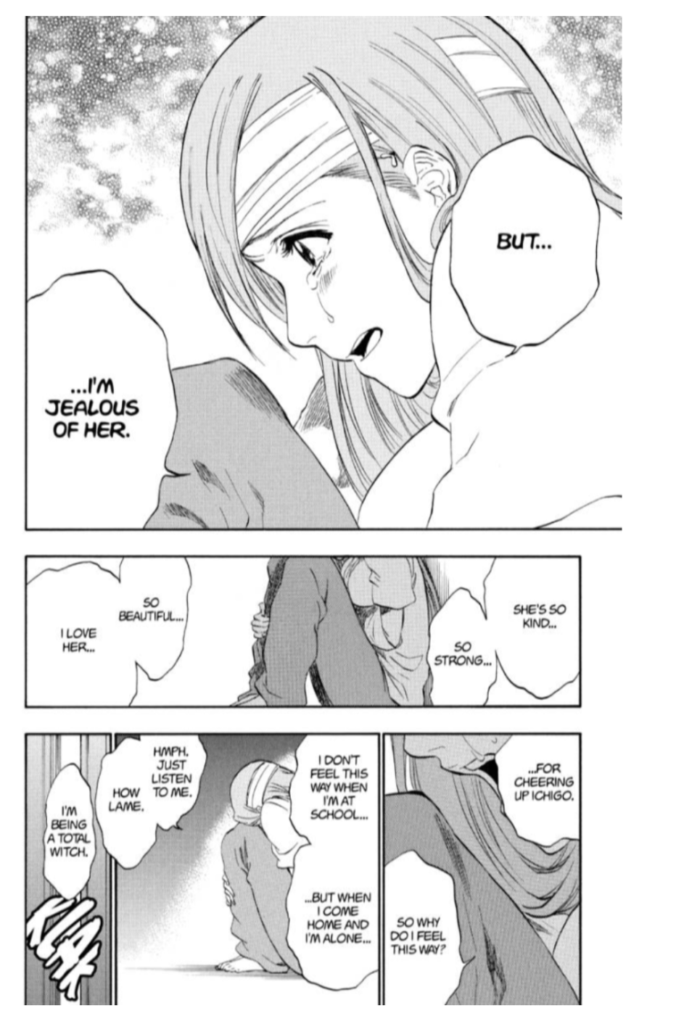
Tite Kubo wrote the Zanpakuto Spirits “Zangetsu” for Ichigo to accept his identity. Self-acceptance is a common topic within each arc of the series. Ichigo had to accept his power as a Soul Reaper and his Quincy background. His fear of “White,” the Hollow Zangetsu, was showing what essentially is the fear of yourself. Since he didn’t realize that White was there to protect him, Ichigo was scared of White hurting the people he cared about. Other characters also go through self-discovery. Uryu Ishida had to find a path as the “last” Quincy because his father rejected that life. A lot of people in oppressed cultures, and people who have had to immigrate and assimilate to a new culture, can relate to navigating an identity that their family and society shuns. Orihime Inoue, a human friend of Ichigo, often feels useless for not being able to help Ichigo and the rest of her friends as well as others can. She feels weak and envious. Many people, especially young women, can relate to her because everyone else seems more capable of doing things she can’t. On the other hand, Sousuke Aizen, a former captain of the 13 imperial Court Guards, isolates himself at the top because he surpasses their intelligence and power. A person’s corruption can stem from their insecurity. It causes a God Complex which can make someone, like Aizen, try to put himself in a dictator-like power to “fix” what they think is wrong. This type of complex can happen with anyone who has authority, like doctors, dictators, judges, world leaders, etc. When Ichigo defeated him, somewhere in his soul he wanted to be a normal Soul Reaper again. Everyone wants to belong somewhere.
The Seireitei, Central 46, Classism, and Authoritanism
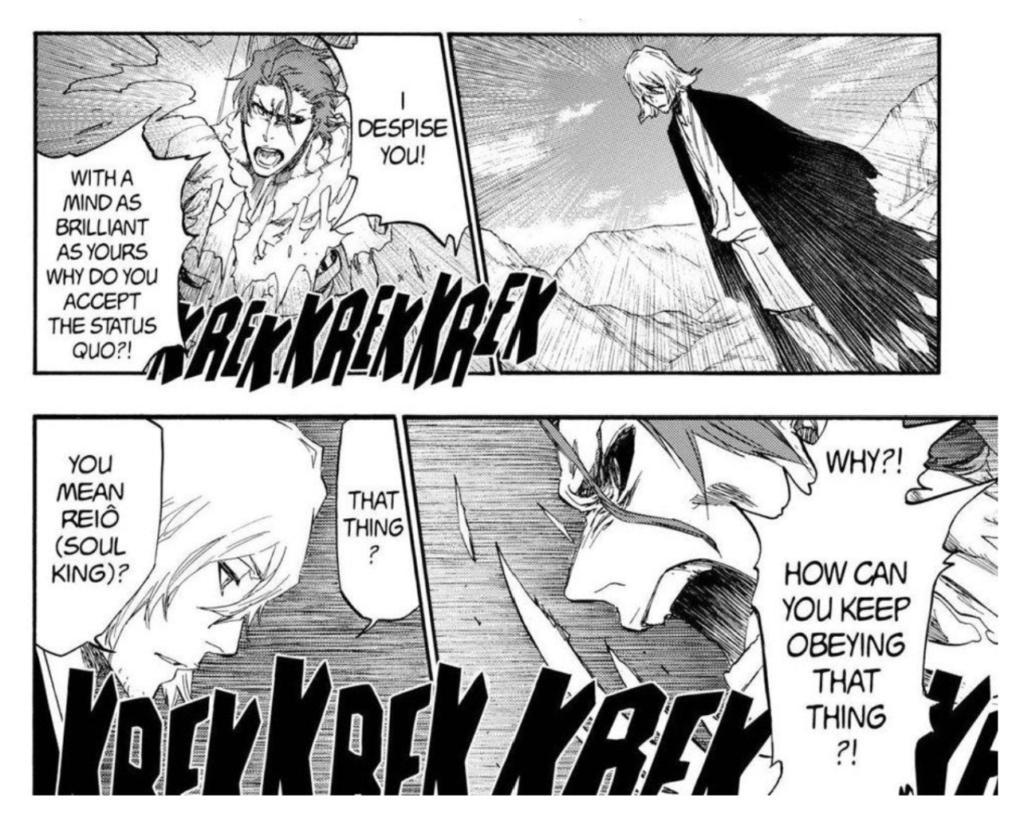
Within Soul Society, there are many allusions to the corruption of modern day governments. The Seireitei is in the center of Soul Society where the 13 Imperial Court Guards (the 13 squads of soul reapers), the Central 46 (the main judicial authority), and noble families reside. Outside of the Seireitei is the Rukongai or “Wandering Soul City.” There are 80 districts in each direction. The danger within these 320 districts is determined by how far they are from the Seireitei. The Soul King technically rules over society keeping the balance of worlds, even though nobody has seen him. The Central 46, which is made up of only nobles and their ideals, works under him. The 13 Court Guards protect the Seireitei and inevitably the Soul King. Aizen is a Court Guard, but he betrays Soul Society. Why? Much like in the real world, Aizen disagrees with the upholding of the idea that Soul King. According to him, the whole system is corrupt. Privileged high-class souls, particularly the Central 46, use the Soul King as a puppet. Lower class souls are living in the most dangerous districts and have no sympathy from the Seireitei. If you think about how our world is going, especially in America where we currently have a corrupt president, you can see how the government is built to protect the privileged rather than the commoners and minorities. Only if you have authority and privilege are you really living a comfortable life. Like I said before, this is the exact scenario a God Complex is formed. Aizen wants to live beyond a broken society by creating a new one.
Arrancars and Human Flaws
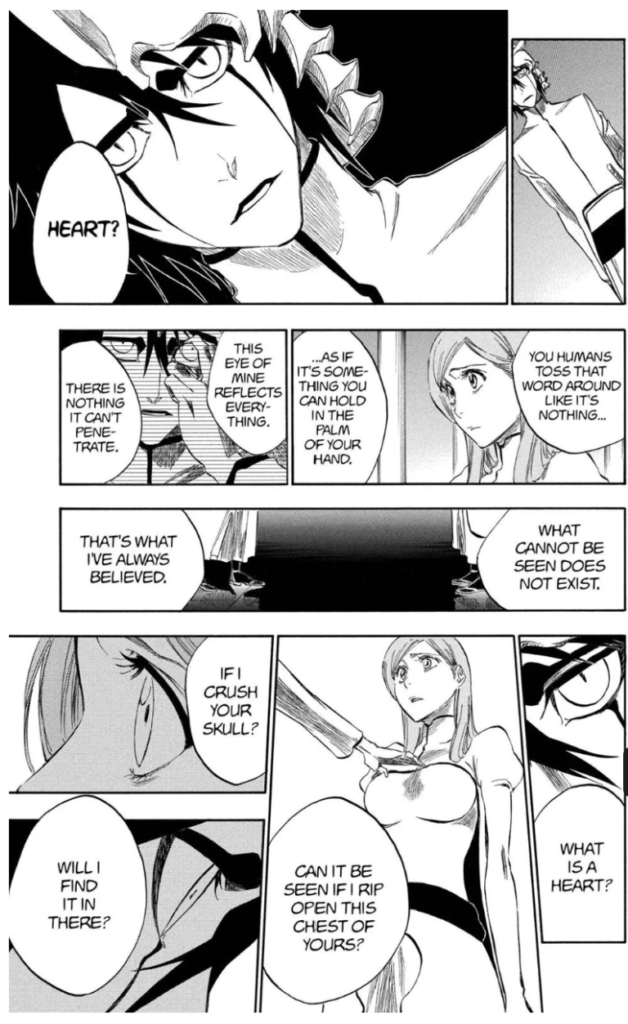
Hollows are creatures with masks on their face. Breaking the mask usually kills the hollow. But, a mask that is merely cracked creates an Arrancar, a Hollow possessing shinigami-like powers. An Arrancar can naturally occur but Aizen’s use of the Hyogyoku, an orb that has properties beyond the barrier of Soul Reaper and Hollows, lets him create them artificially. The strongest Arrancars are the Espadas, ranked through 0-9, and each of them die in symbolic ways. Starrk and Lilynette are two parts of the same soul separated into two representing solitude. Starrk’s death was influenced by the despair he felt when realized that Aizen let the rest of the Espada die. That left him to die in complete loneliness as his partner died before him. Tier Harribel represents sacrifice. She focused on protecting others and eventually became stronger when her friends gave everything for her. Grimmjow was in pursuit of being a king which meant he destroyed anything in his path. His path of destruction led to his defeat by Ichigo Kurosaki. Ullquiorra, whose namesake means “the one who cries,” couldn’t comprehend human emotions or their reasoning to fight and protect. He was the embodiment of emptiness and nihilism right until his realization at his death. Tite Kubo wrote the Espadas to construct the ideas of life and death and contrast Soul Reapers with the “heartless” Hollows that hold consumed souls.
Thousand Year Blood War
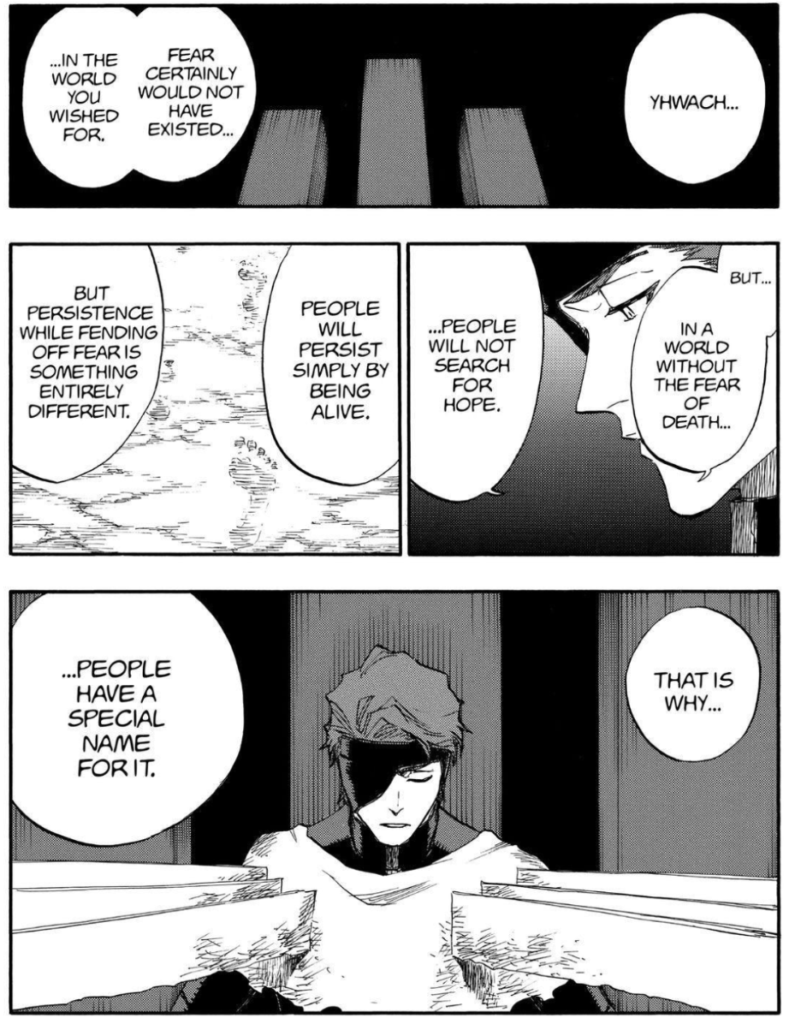
The Thousand Year Blood (TYBW) is the centuries old conflict between Quincies and Soul Society. Because the powers of Quincies cause an imbalance of souls by erraticating Hollows, Soul Society made the decision to start a war. This genocide, meant to erase all Quincies, ha survivors. With the survivors residing in the Wadenreich (Wandering Empire) that they hid in the Seireitei they planned an attack against Soul Reapers. Taking 9 centuries to come back, Yhwach launched his army, The Sternritters. The Quincies are largely based on the German military with many fans noting the similarities they have with Nazi Germany. They view their powers as better than that of Soul Reapers and even within their own kind, Echt (pure) Quincies are preferred over Gemischt (mixed) Quincies, like Ichigo, who are treated as inferior. The TYBW shares
similarities with World War 2 as it started with idealogical differences into the mass genocide of a whole race. However, the key difference is that the Quincies took revenge. After Auswahlen, some of the abandoned Sternritters, like Giselle, Liltotto, and Bazz-B, decided to go after their leader Yhwach even if it meant working with their enemy. In our world there are many times where a leader will abandon soldiers on the battlefield as an expendable pawn to give themselves the upperhand. A prime example of this is the Dunkirk evacuation where more than 40,000 soldiers were left behind and with America, POW/MIA cases have an estimated 81,000 unaccounted personnel.
Additionally, when the Soul Reapers won, most evidence and information about the genocide was hidden. Sound familiar? When was the last time the victors of war had admitted their wrong doing? There is a saying I’ve heard a few times in my life, “War crimes by one side never justify war crimes by the other.” The squads that had roots in the war had their roles repurposed, erased from duty. The hunting down of remaining Quincies by Mayuri Kuroshituchi, the squad 12 captain, was dismissed by Genryusai Yamamoto to deliberately hide what was happening. And, since younger generations of the 13 Court Guards didn’t live through that experience, they are made to believe that all Quincies are extinct and that there is nothing to worry about. Eventually this hidden truth made Soul Reapers fundamentally weaker than before.
What To Do With This Information
The reason for gathering this article was to help push readers to change their perspective and media literacy. I’ve noticed, as a young analytical reader, that the newer generation has a lot of trouble understanding nuances hidden between panels. Each character has a story and personality that relates to all types of people. Behind each power, zanpakuto, resurreccion, and schrift there is relevance to humanity. But there are far too many people too shallow to realize this. They come after the women of Bleach reducing them to fanservice and romance or calling characters horribly written just because they can’t understand them. There are characters with less depth than others but they have a personality that transcends fiction.