
The Psychology of Bojack Horseman

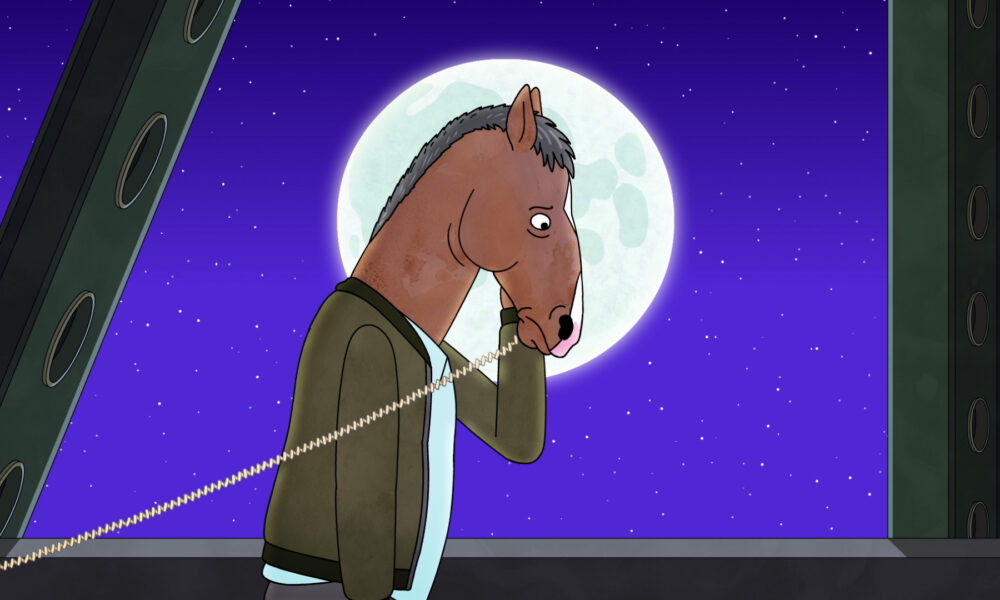
Bojack Horseman is an infamous show surrounding, you guessed it, a horse-man. But this is not any normal horse, this is a horse with a deep, distinguished story line articulated perfectly to make you not like him. With Bojack Horseman we see almost no real character development, he is the cliche self-loathing addict actor living in a luxurious mansion in Beverly Hills, L.A., and doing his best to get by. On his journey through life, Horseman becomes acquainted with various characters who although seem more functional, are in their own way just as flawed, each representing their own lesson to both Bojack and us, the audience. This article will contain spoilers, but keep reading if you want to learn more about what these characters can teach us.
Heads up! This show is a cartoon, but it’s also rated TV-MA, for ‘Mature Audiences.’ It’s got mature themes like adult themes, foul language, and animated violence.
Bojack Horseman
The most important lesson to first analyze is the main character, Bojack Horseman. Bojack makes many mistakes throughout the show from small comedic ‘ha-ha’s’ like stealing muffins to more serious run-downs like sexual harassment and assault. The big idea with Bojack is that he is destructive, not only to himself, but to those around him as well. Those who have the misfortune of meeting Bojack end up feeling pretty bad, and Bojack usually plays at least a partial role in their issues. He detrimentally damages those who come into contact with him and his effects usually have a lasting impact. Now Bojack usually doesn’t mean to be as destructive as he is, but nevertheless it does not lessen his damage. He is a nihilistic, self-loather who has suffered, and his suffering makes others suffer. He isn’t blind to this, in fact he is well-aware, and yet he always plays the victim and refuses to take responsibility for his wrong-doings, often blaming them on his (well-justified) short-comings.
The whole thing with Bojack is that he refuses to take accountability and he refuses to see that change is possible. He believes that you are good, or you are bad, so he is, therefore, bad and there’s nothing he can do about it. “It doesn’t get better and it doesn’t get easier.” He says on the show. “I can’t keep lying to myself thinking I’m gonna change. I’m poisoned. I come from poison and I have poison inside me and I destroy everything I touch.”
Many times he’s been told that there is still hope in change yet no matter how many chances he gets, he still is that same destructive horse. Bojack teaches us that change is hard, and it is something that requires effort on a regular basis, but also that some people just can’t handle change.
Princess Caroylnn
Some characters try to help Bojack, often disregarding their own health and priorities. The most important of these people is Princess Carolynn. Carolynn is an agent in the L.A. scene who briefly (on and off for approx. 7-8 years) dated Bojack and remained in love with him for all 25 years of knowing him and being his agent. She is an independent do-it-all woman workaholic who never has time for herself. Her phone constantly rings for help either from Bojack or from some other character in the show.
Caroylnn often uses this mechanism of helping those in need as an outlet from her own problems; “Because my life is a mess right now and I compulsively take care of others when I don’t know how to take care of myself.” (Episode 9. Season 3) She often finds herself fixing things that can’t be fixed, and in turn hurting herself further in the process. She always runs to Bojack with knowledge that he will never value her or love her like she loves him and thus she steadily remains the figure in the background ready to hop back into his life whenever she seems to be needed. Carolynn teaches that you can’t save everyone, and that some people like Bojack will continue to struggle and pull you down with them. The only thing you can do to avoid this is to just accept that you can’t always fix or help other people. You must help yourself.
Todd Chavez
Naivety tends to be what leads us to less than ideal situations. While Todd Chavez’s naive, bright-eyed, forgiving and ‘let it happen’ nature may at first look like a bundle of positive attributes, he does end up barreling down a generally dark path. Todd is Bojack’s 20-year-old roommate (or rather freeloader) who is seen throughout the show going on silly adventures and ending up in rather funny or awkward situations that make him the loveable character he is. Bojack and Todd are co-dependent, even though they don’t want to admit it. Bojack was afraid of being lonely, and Todd needed someone to take care of him.
Todd lacks conviction. In contrast to his cheerful optimism and creativity, Todd struggles to commit to things and show responsibility. When you are unable to commit, it shows a lack of maturity, and while it does make him a loveable character, Todd teaches that you cannot go through life using luck and charm. Todd’s lack of conviction often put him in less than optimal situations where even in his relationships he lacked the confidence and maturity to stand up for himself, often hurting himself and others. For example, his old friend Emily was led on by him because he could not build up the courage to tell her he was asexual. Bojack is constantly seen belittling Todd, and Todd does not have the confidence to stand up for himself.
Todd often overlooks situations that make him easy to be taken advantage of by Bojack. Being dependent on the actions and generosity of the people around you in order to be able to function day-to-day often puts you in a tough position where you have to suck it up even when it bothers you and in the end have a possible explosion where everyone gets hurt. In Season 3 Episode 10, Todd finally stands up to Bojack, saying “You are all the things that are wrong with you.” Todd tells Bojack that understanding your pain doesn’t excuse the pain you cause, and just because you know you are ‘bad’ doesn’t make you any less horrible.
Todd teaches us that living without real conviction can lead to self-destruction, and real growth stems from taking responsibility and setting boundaries, even with those dear to you.
Mr. Peanutbutter
Optimism is seemingly looked at as something that is definitively good. But sometimes optimism can be used as a tool to avoid uncomfortable situations, and nobody enjoys hanging out with someone who always sees the world through rose-colored glasses. Mr. Peanutbutter is the loveable, optimistic, silly friend character that is seen as the opposite of Bojack, who likes to hide in his sorrow instead.
The issue with Mr. Peanutbutter is that he uses his optimism as a shield, and depends on his likability and charm to get what he wants. Mr. Peanutbutter tends to avoid hard conversations, confrontation and anything that might make him or other people uncomfortable. His dependence on being liked often makes him overlook how people are actually feeling. In Season 5, Episode 8 we see all Mr. Peanutbutter’s past partners experience the same scenario where Mr. Peanutbutter overlooks how they feel (where they felt very uncomfortable) in order to make sure everyone has a ‘good time.’ This caused all of those relationships to blow up. When he asks his old partner Diane why this keeps happening she says, “you don’t ruin these women, they just grow up…. You have to grow up because otherwise they’re gonna keep outgrowing you.” Throughout the show we see him struggle to force people like Bojack, who almost can never be happy, to be the same optimistic dog that he is, but that just can’t happen.
Mr. Peanutbutter shows a great amount of immaturity by being someone who is too optimistic, can’t have hard conversations, and always does what he thinks is right regardless of what others want. He ignores other people’s wishes because he thinks he can do better for them. We learn from him that while optimism and charm can brighten your outlook on life, it doesn’t automatically make you a good or kind person. It’s not always sunshine and rainbows, and that’s okay because to hurt is to grow.
Diane Ngyuen
Ironically, Mr. Peanutbutter’s partner possesses the opposite problem. Diane Ngyuen is first introduced as Bojack’s ghost writer and Mr. Peanutbutter’s girlfriend, who feels pushed into this new Hollywood world and has to deal with the struggles of becoming a writer. Diane shares many of the same attributes as Bojack, which is what made them grow so close throughout the show. She is an intelligent, self-loathing, introverted character who– like Bojack– deeply romanticizes her sadness, explicitly stating that if not for her sadness she would not have her deep intellectualness that allows her to be the writer that she is, “Because if I don’t, then all the damage I got isn’t good damage, it’s just damage. I have gotten nothing out of it and it was all for nothing. .. I could’ve been happy this whole time.. What was this all for?” (Episode 10, titled “Good Damage”) Here we see Diane having a sort of crisis because she is afraid that the pain she has had to endure has accumulated to nothing, meaning that her pain was no longer valuable, or deep or anything, it was just pain.
Diane’s fatal flaw is she views herself as an outsider who has had to endure pain that isn’t even comprehensible to the average person. She always looks down on herself and takes her childhood trauma and turns it into fuel for her insecurities. “You’re the cool kids, I’m the nerd I should have known…..Everyone knows I don’t belong” (Season 3 Episode 5 “Love and/ Or marriage”) She constantly speaks about feeling out of place and being ‘different’ when in reality, she’s feeling just as insecure, hurt and out of place as everyone else.
Pain doesn’t make you more interesting or wise, it just hurts. And while yes that does sound contradictory to what I said about Peanut Butter, the key is to find the balance between joy and suffering. And that’s what we learn from Diane, that “sometimes life is a b****. Then you keep living.”


Other Articles

Why AI is awful to our planet
How to Manage Your Time