

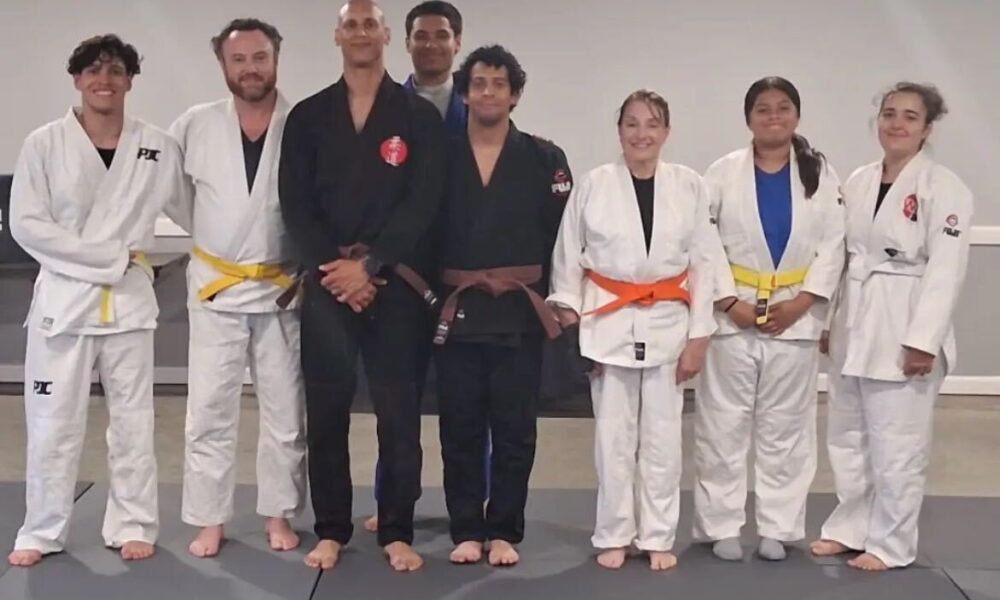
Everyone has their own reason to fight. I started Judo because I needed something that I could do on my own and focus on my mental health more than anything. I also started judo because I enjoyed the physicality of the sport. My friend joined judo because she wanted to try something new. My other friend joined to find his purpose and to also focus on himself. The stereotypes around fighting and fighters are usually completely wrong. Fighting isn’t always about being aggressive, or being the strongest. It can be someone’s peace of mind and it helps people calm down. Many martial arts aren’t always physical but also mental. You have to physically be in shape but also mentally strong and flexible to experience new challenges.
When thinking of Mixed Martial Arts (MMA) you think pro level fighting. Fighters like Islam Makhachev, Paddy “The Baddy” Pimblett, Khabib “The Eagle” Nurmagomedov, Charles Oliveira, and Erko Jun are all recognized as some of the best fighters in the sport. But behind all the professionals, are normal people who have built a community around MMA. Those everyday people choose to fight for their own reason and sometimes it’s not for the reasons you’d think.
Tony DiPrizio, executive director of the Muscles Unlimited Legacy Foundation (MULF) and my sensei, started the foundation to allow kids, teens, and adults to learn a traditional Japanese fighting form, Judo, for free. Judo is a sport of unarmed combat derived from ju-jitsu and intended to train the body and mind. It involves using holds and leverage to unbalance the opponent. He began judo seven years ago because he “was looking for a traditional Japanese martial art. [He] thought of maybe trying Brazilian jujitsu, but [he] wanted to work on [his] throwing.” He started at Pedro’s Judo Center to work on grappling. All his research led to the school, and for the past seven years, he’s been training judo.
While teaching younger students, he states that “it’s the best feeling in the world…like it’s a high you can’t explain.” Being a part of the MMA community, “being affiliated with Olympian Jimmy Pedro and his dojo is huge for [him].” DiPrizio added, “I love being involved with the community [compared to] Army Kombat, which I did for many, many years. It was such a hateful and horrible place. The people that were involved in that, they were always trying to one up each other, who had the best school…It’s weird. Everybody had to worship the person running the whole school, and worship certain fighters. It was creepy and strange. Once I started over at Pedro’s, I realized that there was a different culture. Through my team and the people that I associate with, we created a bond. It’s actually been really nice, that there’s friendly competition, not where [fighters] want to beat you and prove that [they’re] the best. We all work together and that’s one thing I love about judo. The idea of mutual welfare and benefit. We’re all in this together, You might beat me, I might beat you, but we learned something through our fight. That’s what I really enjoy.”
This program brings me joy, and I’m able to learn Judo with people who find joy in it too. The classes are moderately paced and my sensei wants to make sure each student has a deep understanding of throws, ground control, and counter attacks, which can be used in real-life situations as self-defense or when participating in a match.
Kevin Linehan, a sensei at Uechi-Ryu Mushin gym, has been doing Uechi Ryu Karate, a blend of Chinese boxing principles with Okinawan karate techniques, emphasizing harmony, timing, and real-world combat effectiveness, for 33 years, and Brazilian Jiu Jitsu, a ground-based martial art and combat sport that emphasizes leverage, technique, and submissions to allow a smaller or weaker person to control and defeat a larger opponent deriving from Judo, for 11 years. He described the Jiu Jitsu community as “more laid back, [because] you can go anywhere in the world, then pick it up, and they’re your best friends… Some schools, a little different, but for the most part, anywhere you go, you can go train. [Unlike Karate], it depends on affiliations, we have different associations across the world. Sometimes, they’re very welcoming, and, unfortunately, sometimes they’re not. For my style, we are definitely trying to get back to when a lot of the doors were open and people trained together. It’s just taking some time.”
Linehan started Karate at the age of seven via his father putting him into it. His father trained in the style and Linehan stuck with it. His son and daughter trained with him and his wife when he opened the school. Linehan started to train Jiu Jitsu because “everyone I trained with in Karate was older, like much older than me. So, I had friends, but they were like 60 and I was 25. So, Jiu Jitsu, I went into to make friends my own age,” he said. “And then I completely fell in love with it. So I cross-trained both every week.” Overall, Linehan is “glad it’s growing.” He continued, “Stuff like this, martial arts, if we could get it to kids younger, I think bullying and self-esteem and things like that, like, we’d see a decrease in bullying, we’d see an increase in self-esteem. It’s so important that MMA is part of people’s lives, whether they’re taking a singular style or mixed martial arts together. The benefit of having a community like that, especially in the right school, can definitely help anybody at any age feel a little bit more confident and a little bit better about themselves.”
An anonymous interviewee, one of my friends, has been doing MMA for over 12 years. He does kickboxing, capoeira, and boxing. He’s been doing kickboxing for nine years, capoeira for 12, and boxing for six years. He stated how he “specifically chose kickboxing as [his] main/favorite though because it’s an all-arounder type of martial art.” He shared, “Overall, the MMA community is definitely one of the most supportive as well as one of the most competitive communities, simply because the skill ceiling is high and so is the amount of people who strive to get better at what they do.”
Overall, the MMA community has its own branches, which all have their own effects on people. Not all communities are safe havens to be in, and not all of them are welcoming. The welcoming communities are well structured, as I’ve been in both welcoming and not welcoming. Being able to find a community that I find joy in and feel comfortable being in is important to my mental and physical wellbeing. My judo and MMA community is very welcoming and being able to find one for yourself and find people around you who will push you to be the greatest version of yourself.


Other Articles

Moulin Rogue! The Musical… A Missed Opportunity
Boycott Nestle