
The Vietnam War: Championing Freedom or Compromising America’s Character?

On July 4, 2026, America will commemorate the anniversary of its founding, marking not only 250 years since the Declaration of Independence was written by the Founding Fathers, but the igniting of a new revolutionary spirit that quickly spread throughout the globe, inspiring many colonies to embody the ideals of the United States. In celebration of this momentous occasion, Salute to America Task Force 250, a White House initiative established through executive order in January 2025, has organized an array of patriotic festivities under the direction of U.S. President Donald Trump. The activities leading up to the historic milestone are set to include nationwide exhibits, fairs, and athletic competitions. According to the White House, these celebratory events are meant “to inspire a renewed love for American history, encourage citizens to experience the beauty of our country, ignite a spirit of adventure and innovation to help our nation succeed for the next 250 years, and invite Americans to pray for our country and our people and rededicate ourselves as One Nation Under God.” Although the Founding Fathers’ values of freedom, equality, and individual rights have transformed into worldwide ideals in the two centuries since the Declaration was first written, these principles have never truly been translated into practice. The United States may have been founded on the concept of self-determination, but this nation is noticeably much less apt to follow its own ideals when they contradict its interests—a phenomenon prominently exhibited during the U.S. intervention in the Vietnam War.
Widely regarded as one of the biggest mistakes in American military history, the United States poured much of its capital and manpower into fighting the Vietnam War during the 20th century. Fearing the increasing influence of the Soviet Union during the Cold War, America became the self-proclaimed defender against the spread of communism using a new approach called “containment.” Developed by diplomat George F. Kennan and enshrined into American foreign policy through the 1947 Truman Doctrine, the strategy of “containment” focused on limiting Soviet expansion through policies such as providing aid to external governments fighting communist forces. In other words, foreign intervention was inevitable. Beginning as early as 1944, the U.S. sent military advisors to Vietnam in order to assist the French in maintaining their Indochinese empire. Following French withdrawal from the region, the U.S. became directly involved in the conflict. On November 1, 1955, President Dwight D. Eisenhower deployed the Military Assistance Advisory Group to train the South Vietnamese. By 1965, President Lyndon B. Johnson authorized the deployment of active combat troops, significantly escalating the conflict. America’s decision to intervene in the Vietnam War was a moment in which it faltered in its unwavering commitment to freedom.
Although the Vietnamese nationalist movement sought independence from French rule, the U.S. chose to back France due to its frantic fear of communism. Rather than following the principle of self-determination, an ideal established by the Declaration of Independence’s statement that, “Governments are instituted among Men, deriving their just powers from the consent of the governed,—That whenever any Form of Government becomes destructive of these ends, it is the Right of the People to alter or to abolish it, and to institute new Government,” the U.S. made the decision to actively suppress the liberation movement in order to ensure that the Vietnamese people followed an ideology that the U.S. believed was correct. Many scholars argue that the United States’ support of French rule displayed its endorsement of imperialism—the very type of oppression that it had fought to escape from two centuries prior. In hindsight, many American citizens who lived through the war, including. soldiers who actively participated in fighting, came to agree that interfering in Vietnam rather than allowing the fledgling nation to develop their own beliefs was a mistake. When interviewing Corporal Robert Kaufman, a veteran of the war, he stated, “[The war] was stupid, we never should’ve gone over there […] that’s my opinion. Other people, other veterans, might disagree with me, but it’s just [that] we had no business over there. It was a civil war that should’ve been determined between the north [and the south] in Vietnam.”
In addition to its suppression of Vietnamese freedom and independence, the United States also stripped civilians of their universal rights. In 1995, Vietnam reported estimates of its death toll during the war. According to Britannica, one million North Vietnamese fighters and 200,000 to 250,000 South Vietnamese soldiers, as well as more than two million Vietnamese civilians were killed on both sides. However, these casualties were not simply an unintended consequence of war. Many civilian deaths came as a direct result of war crimes committed by the U.S. military.
The University of Virginia reports that on the morning of March 16, 1968, 2nd Army Lieutenant William L. Calley and his platoon brutally murdered as many as 500 unarmed civilians, including women, children, and the elderly. In addition to shooting down the Vietnamese civilians, the soldiers slaughtered livestock, raped and mutilated an unknown number of women, and burned the village to the ground. Known as the My Lai Massacre, this atrocity is a clear violation of every ideal that America has ever stood for. According to The New Yorker, Army commanders immediately tried to cover up the incident rather than launching an investigation into the alleged crimes. For nearly two years, officials falsified reports and suppressed information, attempting to portray the attack as a negligible engagement against enemy forces rather than the war crime it truly was.
The My Lai Massacre and other wartime atrocities committed by the United States are a clear violation of the Declaration of Independence, which upholds the idea that every person is entitled to “unalienable Rights,” including “Life, Liberty and the pursuit of Happiness.” By launching attacks on civilians without the means to defend themselves, the United States military stripped Vietnamese citizens of their entitlement to life and all other freedoms promised by the Declaration. Attempts to preserve the military’s image rather than holding those responsible for the massacre accountable further bring into question the United States’ commitment to the principles it claimed to uphold.
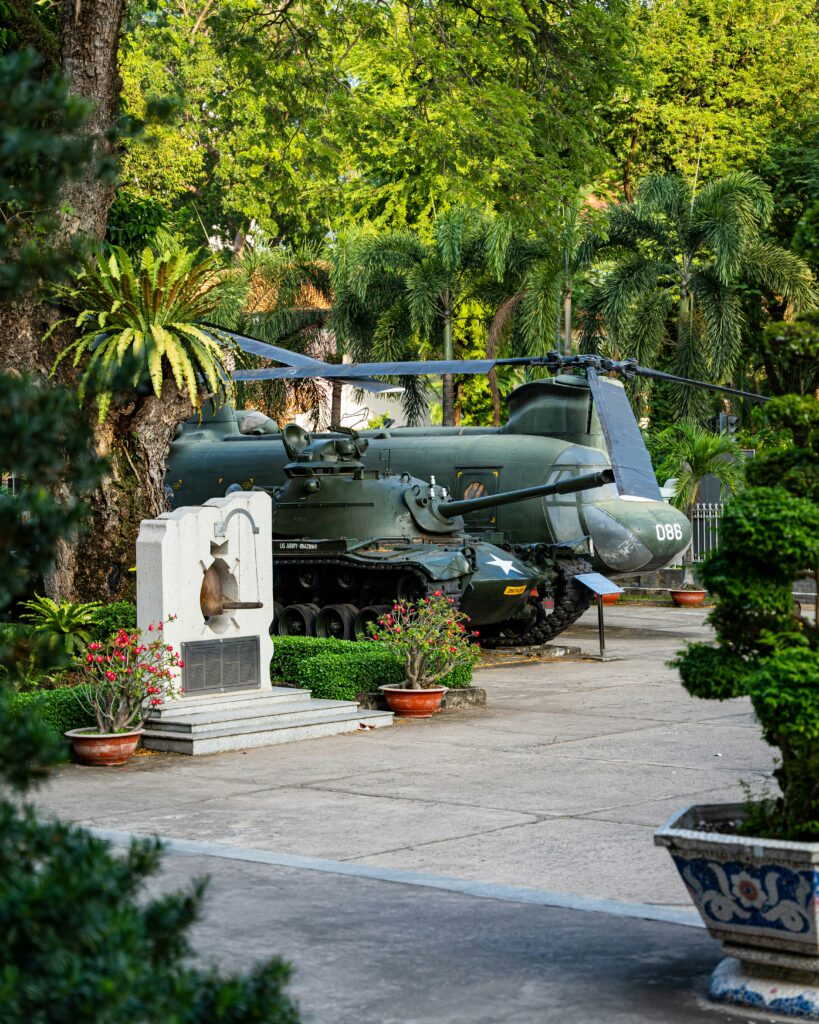
The Vietnam War remains one of the most controversial and deeply divisive wars in United States history. While some view the American presence in Vietnam as an immoral attempt to suppress a national liberation movement, others believe the war was a necessary intervention conducted in the name of democracy. Whatever one may believe, it is crucial to acknowledge the failures of the past in order to create a future where the ideals heralded by the Declaration of Independence are not simply words on a decaying document, but concrete principles that will shape the development of the world for centuries to come.
Five decades after the conflict, U.S.-Vietnam relations are at an all-time high. With the creation of joint policies such as the 2023 U.S.-Vietnam Comprehensive Strategic Partnership (CSP), both countries have showcased their commitment to strengthened cooperation. Current U.S.-Vietnam relations are an excellent demonstration of how despite the legacies of war, past adversaries do not always have to remain hostile to each other—it is possible to become allies working towards a shared vision of international peace, collaboration, and diplomacy.


The State of America as a Civilization
Why Expanding Your Music Genres Is Important