

As someone who is fairly new to attending ballet shows, watching Boston Ballet’s rendition of George Balanchine’s Jewels performance left me truly awestruck. Before the show began, I was welcomed by the Citizens Opera house’s beautiful interior; lush carpeting, and the walls adorned with the most intricate architecture. I believe this was the perfect setting for Jewels, as it matched the rapturous and elaborate energy I felt from the performance. As for the show itself, it honors the legacy of one of the most influential choreographers, George Balanchine. Divided into three sections and two intermissions, each performance explores the unique chapters of Balanchine’s career, such as his training in Russia, his early choreographies in France, and modern compositions in New York. Just as a biography paints a picture with words, Jewels ultimately illustrates Balanchine’s impact on neoclassical ballet through spectacular visuals and dance.
Emeralds – The Dance of Effervescence
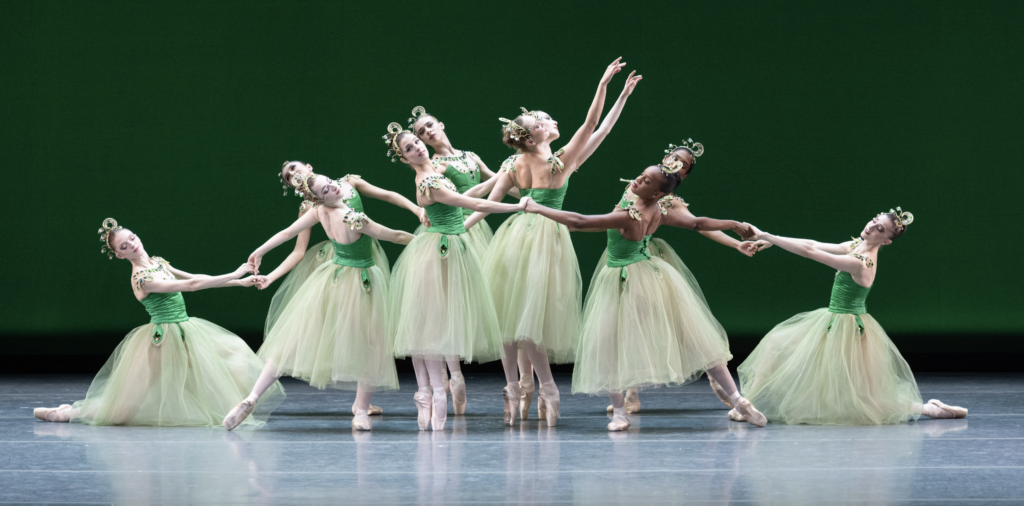
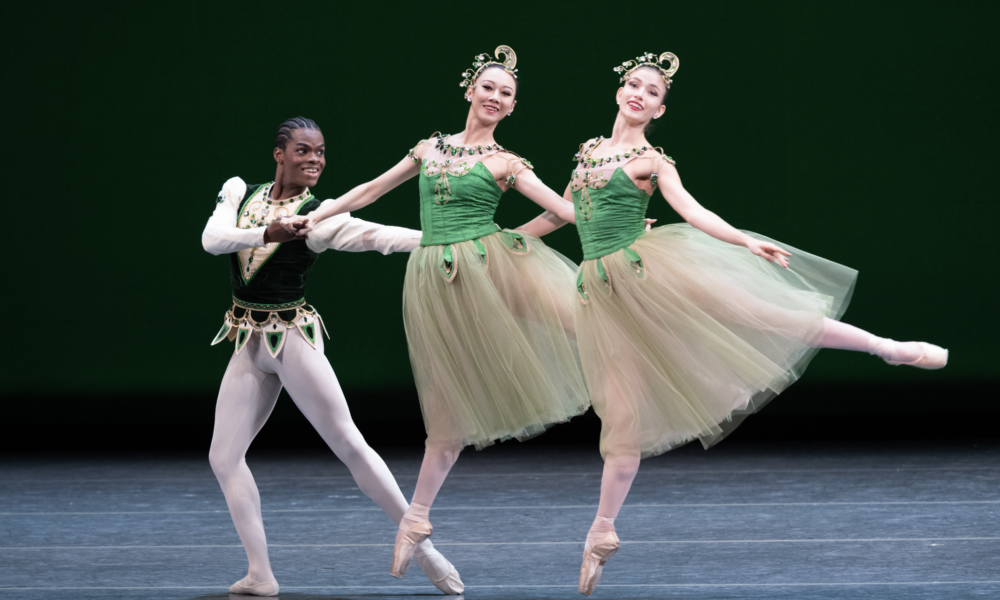
The opening jewel was the emerald, which I felt embodied the theme of effervescence. Reflecting the 19th century French style Balanchine was inspired by, I noticed this piece had many duets and trios, but all throughout, the dancers moved as if floating on air. The costuming choice of tulle skirts for this section certainly helped emphasize this. Even so, it did not take away from the dancers’ precision, as they formed gorgeous group shapes with ease. Overall, I admired this section’s contrast of grace and pep.
Rubies – The Dance of Passion
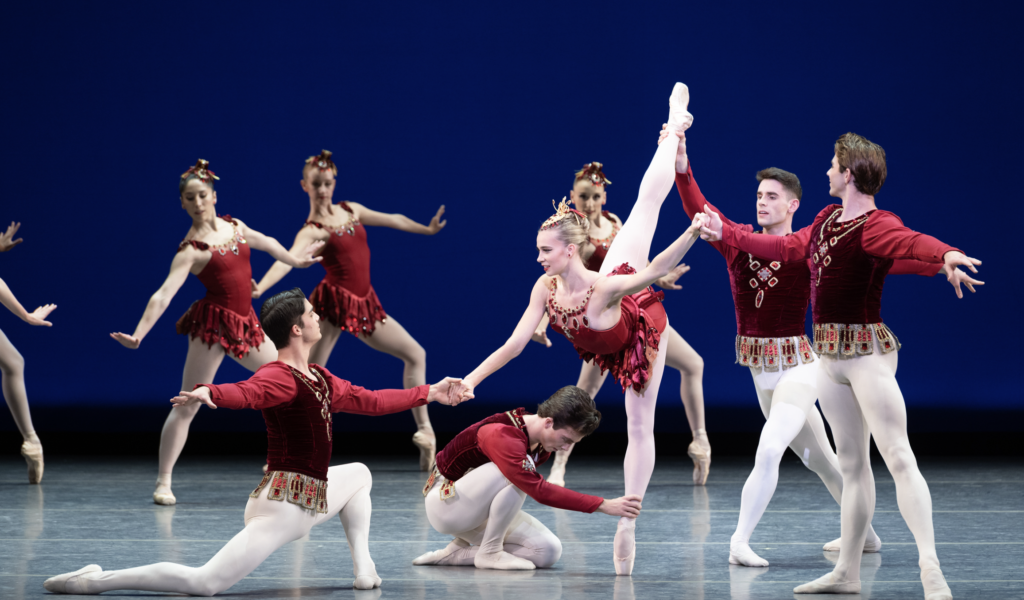
On the other hand, the rubies section was a delightful twist, and upon further research, I understand why. When choreographing the piece, Balanchine was inspired by the jazzy influences of American dance. Another nod into this was the dancers’ more modern outfits –still embellished and bright–but for this section, simpler. This leads me to classify this part with a theme of passion because the dancers led a spunky routine without losing any momentum, reflecting confidence, and a little bit of fun, like in a particular duet where dancers Ji Young Chae and Jeffrey Cirio shimmied about in some parts, which balanced the gravitas with a tone of lightheartedness. Even so, a small critique I had was this section’s backdrop color. A serene blue was chosen, which I initially thought nicely contrasted the red costumes. Yet, this same hue was used for the last section, the diamonds. To better differentiate these last two sections, just as the emerald had its own color, the rubies section could have been paired with a red background, or had its backdrop adorned with gems as seen in Boston Ballet’s older renditions of Jewels.
Diamonds – The Dance of Elegance
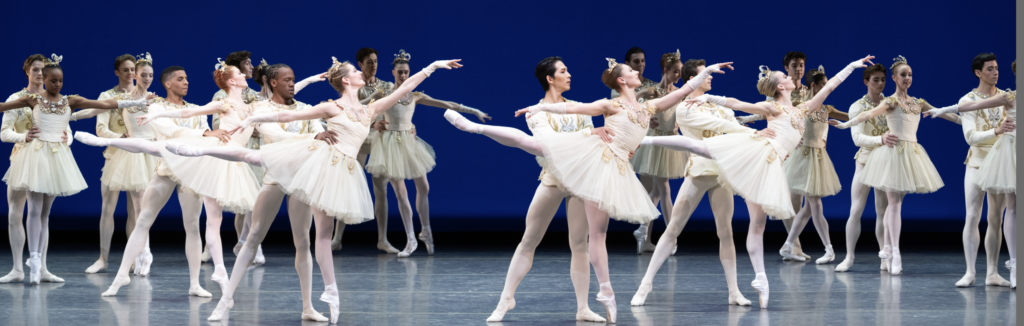
Nonetheless, after the second intermission, the final section came to be; the diamonds. To match the gem’s regality, grand curtains and a sparkling chandelier were added. Plus, the dancers’ pearly white costumes and classic tutus fancied with swirly gold and silver motifs simply topped this last performance with elegance. There were so many dancers on stage at one point, that I didn’t know where to look! Patterns of symmetry and synchronization were maintained so well though, that the stage didn’t look messy or overcrowded near the end, but instead glistened with talent. In my opinion, this section’s music score was the most memorable as the live orchestra captured the progression from the softer beginning, to the intense conclusion wonderfully.
In sum, I quite enjoyed watching this performance. There was never a dull moment, and while I feel there could have been more set design (like the last section, diamonds) I respect the artistic choice taken to let the dancing shine first, which certainly did not disappoint.


Other Articles

Paris Street – A Place Where People Build Connections & Community
Mental Health: A Lifelong Journey of Intention