
A Beginners Guide to Paleontology: The Good, The Bad, The Ugly.

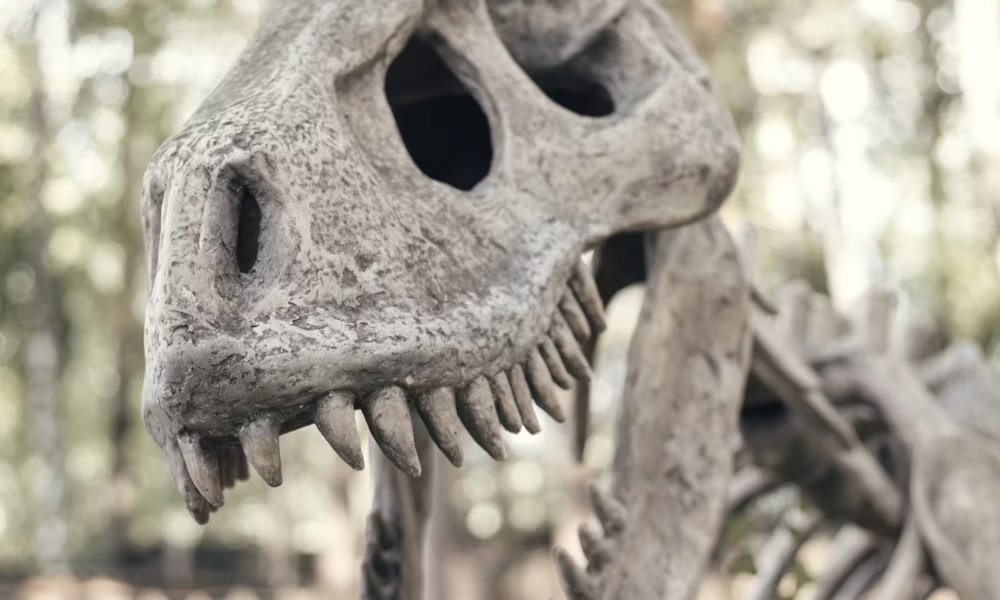
Are you a budding paleontologist who is lost and overwhelmed about your future in paleontology? Or are you just someone who wants to dive deeper into the topic? This article will go over everything a beginner needs to know!
What is Paleontology?
Most of us have heard about paleontology from the popular movie Jurassic Park, but the truth is, paleontology is more than just dinosaurs. Paleontology is a mix of chemistry, biology, and geology. To be more specific, this field focuses on the study of prehistoric life through fossils. Fossils are what remains of early life that was slowly buried underground over thousands of years. Dinosaur fossils are most commonly known, but there are plenty of others like insects preserved in amber, petrified wood, coprolites (fossilized poop), trilobites (fossilized marine arthropods), fossilized shark teeth… the list goes on. Fossils can help determine the living conditions of certain organisms, reconstruct organisms that are extinct, and help determine its behavior.
There are many “branches” of paleontology, called subdisciplines (also known as subfields) which specialize in their own field of study within paleontology. Invertebrate Paleontology, Vertebrate Paleontology, Paleobotany, Evolutionary Paleontology, Conservation Paleontology, Taphonomy, all fall under this term.
Those who work in these fields are called paleontologists. Just like subdisciplines, there are many types of work a paleontologist could do. Some paleontologists take on field work, uncovering and excavating fossils buried deep underground. Others work in museums, where they assist with preserving fossils and putting them on display for the public to see. And a good chunk of paleontologists work in education, as professors in universities.
The Perks of Being a Paleontologist
If you ever find yourself in the life of a paleontologist, you’ll know how fun work can be! Not all paleontologists will strictly stick to one thing, they get to do all sorts of stuff. One month you could be at a dig site in Montana and the next month you could be in a laboratory analyzing your findings. For those who enjoy outdoor work, this job might be the perfect fit for you! Paleontologists are granted the opportunity to travel world-wide. These places could vary from well-known locations, filled to the brim with fossils, or hidden gems with fossils just as unique! Most fossil discoveries were made in countries like China, United States, Argentina, Germany and Canada. If you’re ever interested in more of what a day as a paleontologist could look like, I highly recommend checking out Dr Susie Maidment’s “How to become a Paleontologist”. The page contains detailed experiences of her life and resources that help young students navigate towards becoming a paleontologist.
The most rewarding part about becoming a paleontologist are the contributions you’re making towards science. Every new finding helps pave the way for more discoveries about prehistoric life. Each fossil holds its own story. And there is always more to uncover. The possibilities are endless.
Education and Opportunities
Paleontology is far from a dying field. As a matter of fact, it’s more alive than it’s ever been. So why don’t more people want to pursue paleontology?
For starters, paleontology is a super hard field to get into. The lack of support for young students is enough to deter most from wanting to commit their life to this field of research. High school students who express interest in wanting to pursue paleontology as a future career can find themselves having a harder time than most students when it comes to support from career counselors. Support for careers like these are often lacking compared to other well known career choices.
The opportunities are even harder to find. According to GeoScienceWorld (GSW) the number of job seekers far exceeds the amount of job openings available, making the field highly competitive. Those who are already in the field are here to stay, resulting in scarcer opportunities. There has been a 50% decline in vertebrate paleontology starting from 2023, followed by a 23% drop in university rates. The demand for paleontology has only been growing, seen by an 80% increase in community college and 4 year college.
What does this mean? Well, the demand for opportunities within the paleontology community will only grow bigger and bigger, while job opportunities continue to decrease.
What You Can Do
Being a paleontologist is no easy feat. The road will only continue to get harder as the years pass, but don’t let that stop you. It’s no lie that paleontology is something you have to be extremely passionate about no matter the opportunity, support, and salary. The community is super welcoming and filled with kind individuals who can help you navigate the hardships. As for what you can do, here’s a few things you should do to ensure you have the best chance possible.
- Don’t jump straight into paleontology as a major in college.
Not many colleges offer paleontology as a major, and not many may be in your state. Remember, paleontology consists of other subjects like geology, biology, chemistry, anthropology, geography, and zoology. It’s best to pick broader options like geology or biology to widen your specialities rather than limit yourself to just one. This will work as a safety net.
- Get involved.
Volunteer at your local museum with a fossil collection, reach out to a paleontologist in your area, join programs with science related topics, get involved in the scientific community! Take this as a learning opportunity to learn how to prepare, identify fossils and much more. Build the necessary connections that will open new doors to more opportunities in the future. Don’t be afraid to talk to people, they’re here to help you.
- Believe in yourself.
Being passionate is one thing, but what’s more important is believing in yourself. The life ahead of you won’t be easy, and you will need to dedicate your life into this career- just like plenty of other ones. There will be times where people will try to convince you otherwise, don’t believe in them. You alone decide what makes you happy. And if doing what you love most makes you happy, then who are they to tell you otherwise? As long as you keep pushing and work hard, anything can be possible, no matter the difficulty.
A Few Words From The Author
So to all my future paleontologists, I hope you will find this path bountiful. No matter how hard this path can be, it will all be worth it in the end. Remember, If you don’t try, you’ll never know, so give it your best shot!


Other Articles

PAX East Food Review
Every Word Births a Butterfly